Showing posts with label Electricity storage. Show all posts

Tuesday, 18 August 2020

London bus depot to provide vehicle-to-grid power during peaks


E-buses (Source: The Driven)

A North London bus depot is on the verge of becoming one of the world’s largest vehicle-to-grid (V2G) virtual power stations. The Northumberland Park bus garage will be transformed to be part of UK’s Bus2Grid project. 


The project will enable electric buses parked at the garage to plug in and feed stored electricity back into the grid to provide grid balancing during times of peak demand. It was announced by British energy firm SSE Enterprise and is being conducted in collaboration with bus operator Go-Ahead London


A trial will test 28 electric double-decker buses, which are capable of returning over 1MW of electricity back into the grid. The project could then be expanded by the end of 2021 to include the capability of connecting up to 700 electric vehicles to the grid, supplying as much as 25MW of electricity. 


Read more: 

- London bus garage becomes one of world’s largest vehicle-to-grid sites. The Driven, August 14, 2020. 

London bus garage becomes world’s largest vehicle-to-grid-site. SSE Enterprise. Accessed August 18. 2020.

Thursday, 23 April 2020

Can “solar hydro" replace coal and gas-fired power stations?


Organic Rankine Cycle (Source: Applied Sciences, 9 (1) 49, 2019)

RayGen, with the support of AREA (Australian Renewable Energy Agency) and in collaboration with other companies, is on-track to test a 50MWh “solar hydro” project in NW Victoria. The plan is to eventually develop a 200MW solar power plant with around 100MW/1000MWh storageThis is enough to help replace retiring coal and gas fired power stations.

The plant will consist of mechanical mirrors on the ground concentrating sunlight and heat to RayGen’s efficient collector on a raised tower. The collector consists of mirrors and super-efficient PV modules which can collect both light and heat. The specialist panels convert about 30 per cent of the sunlight to electricity and capture around 60 percent of the excess heat. 

The heat is stored as hot (92°C) water in one reservoir while the electricity is used to chill water to 2°C, which is stored in a cold reservoir. Between the two tanks is the Organic Rankine Cycle system (see above diagram), which has a special organic fluid circling within it. At the evaporator, the fluid is heated to a gas by the stored hot water which then drives a turbine to generate electricity. The organic gas then passes to the condenser where it is cooled back to a liquid by the stored cold water. 

With the organic fluid coming to boil at a lower temperature than water, it means that the system has a high efficiency. Since the water temperature differences are stored like a battery in the reservoirs, the system can generate electricity when required. “The temperature difference of about 90°C has a similar energy storage capacity as pumped hydro with a height of 1000 metres – so really, really big pumped hydro.” says RayGen’s Will Mosley. “RayGen is able to deliver the economics of pumped hydro and the flexibility of batteries.” (RenewEconomy

Read more: 
- RayGen edges closer to “solar hydro” success with new strategic partnerships. RenewEconomy, April 16, 2020. 
- World-leading solar technology born in Melbourne, that’s ultra-cool. ARENAWire, September 28, 2017. 
Solar power plant phase 1. ARENA, January 2020. 
- Renewable energy storage, solar power technology. RayGen

Tuesday, 14 January 2020

South Australia now has 3 big batteries and they made $1 million over two days!

Source: RenewEconomy

The Lake Bonney big battery (20MW/52MWh) in South Australia is now in full production. It combined with the two other big batteries: Hornsdale Power Reserve (100MW/129MWh) and Dalrymple North battery (30MW/8MWh) to jointly make A$1million over two days. This occurred on Thursday 19 and Friday 20 December 2019 when Australia was experiencing the three hottest days ever recorded on Tuesday, Wednesday and Thursday of that week.

The Lake Bonney battery started full production in late November and was therefore ready to support to the eastern Australian grid. During this very hot week, electricity demand was great and consequently the prices went very high. This high pricing also coincided with low electricity generation from wind and solar. As a result, expensive gas and diesel generators were needed to meet demand. Being both dispatchable and fast responding, batteries were well placed to take advantage of this volatility in pricing.

South Australia aims to have net 100% renewable electricity by 2030 so large batteries are seen as a move towards this. Therefore “a fourth battery in South Australia, a 10MW/10MWh battery installation at  Lincoln Gap wind farm is set to join the grid in the new year, while  Sanjeev Gupta’s Simec Zen Energy plans a bigger 135MW battery at Port Augusta and Tilt Renewables is also considering a 20MW/40MWh battery at its Snowtown wind park.(RenewEconomy).

Read more:
- Infigen says Lake Bonney battery now in full production. RenewEconomy, December 12, 2019.
- South Australia big batteries earn $1 million over two days. RenewEconomy, January 15, 2020.
- Tesla big battery delivered a $22 million profit in 2018. RenewEconomy, May 14 2019.

Monday, 6 January 2020

Alternative green electricity storage options being considered in the USA

Source: What's next in long-term energy storage, Vox.

Lithium-ion batteries are not the only way to store renewable electricity. The US Department of Energy’s Advanced Research Projects Agency (ARPA-E) is funding research by 10 organisations to create long-term energy storage systems that cost US$0.05 per kilowatt hour or less.

It is called the DAYS (Duration Addition to electricitY Storage) Program. The DAYS Projects fall into two categories: 1. Systems that provide daily cycling in addition to longer duration, less frequent cycling 2. Systems that do not provide daily cycling, but can take over when daily cycling resources are either filled or depleted.

A list of DAYS Projects is provided here but please refer to the links below for more information.
- 1. Sulphur Flow Batteries.
- 2. Innovative electrolyzer/fuel cell combination using hydrogen peroxide for storage instead of hydrogen.
- 3. Zinc-bromine flow batteries.
- 4. Thermovoltaics. Using PV panels to make electricity to heat carbon blocks.
- 5. Electricity to magnesium manganese oxide.
- 6. Pressurising water underground.
- 7. Liquid Air Energy Storage.
- 8 to 10. Three other electricity to heat programs aim to raise the efficiency of storing electricity as heat then using it to heat a gas to drive turbines. (DAYS Project Descriptions, ARPA-E).

Further reading:
- Department of Energy announces new projects to extend grid energy storage. APRA-E, September 18, 2018.
- APRA-E: Duration Addition to electricitY Storage (DAYS): Project Descriptions (pdf)
- Energy Storage 2020: It’s not just about lithium-ion batteries any more. CleanTechnica, January 5, 2020.
- U.S. research teams aim for long-duration storage at $0.05/kWh. PV Magazine International. December 30, 2019.

Tuesday, 26 November 2019

Solar energy produced “water battery” wins global award and saves 40% of university’s energy use

"Water Battery" and solar panels at the USC (USC website)

The University of the Sunshine Coast (USC), Queensland, Australia, wins an award at the 6th Global District Energy Climate Awards which was presented in Iceland in September 2019. The award was for their “water battery”, featuring 6,000+ solar panels and a thermal energy storage tank, that is cutting grid energy use at the Sunshine Coast campus by 40 percent.

The USC has a goal to become carbon neutral by 2025 and to operate sustainably. The Sunshine Coast campus uses a lot of electricity, so in order to achieve that goal they had to come up with a way to store energy without using chemical batteries which have a waste problem.

In collaboration with Veolia, the USC installed a massive rooftop solar system and built a thermal energy storage battery with a thermal chiller. When the sunshines (which is often in this location), solar energy powers the thermal chiller to cool water which is stored in a massive tank. The chilled water is used to air condition the entire campus.

Read more:
- Sunny approach to cooling campus wins global award. University of the Sunshine Coast, October 28, 2019.
- Clean Energy (How it Works): Sustainable USC, University of the Sunshine Coast.
- Sustainable USC, University of the Sunshine Coast.

Wednesday, 13 November 2019

Renewable microgrid saves lives and helps folk in the Californian wild-fires

Blue Lake Rancheria Microgrid, CA (One Step off the Grid)

The Blue Lake Rancheria microgrid saved lives when its owner welcomed in the broader community during the recent sweep of wild-fire related power shut offs in northwest Humboldt County, California. The Rancheria and its estate are owned by three Indian tribes.

The microgrid kept the tribes’ casino, hotel and offices powered up and enabled the tribes to set aside some of its hotel rooms for medical patients who needed electric power for their medical devices. This assistance saved at least four lives.

The microgrid also provided a safe, warm environment for local families to charge mobile phones and access the internet; power to charge electric vehicles; and it was also able to provide a mobile office for Humboldt’s daily newspaper. The tribes served about 10,000 people during the electricity outages which were enacted to lower the fire risk.

The Rancheria has a 430kW solar photovoltaic array with a 500kW, 2kWh Tesla battery storage system complemented by two legacy diesel generators with a combined capacity of 1.8MW. There are plans to upgrade the microgrid next year.

Read more: How a renewable microgrid saved lives in the California wild-fires. One Step off the Grid, November 14, 2019.

Wednesday, 25 September 2019

Australian billionaire to support world’s largest solar farm for export and local use

Source:RenewEconomy

Billionaire, Mike Cannon-Brookes, and other Australian entrepreneurs have confirmed financial support of a $25 billion dollar plan to build a 3,000km undersea cable to export solar energy to Singapore and to supply Darwin. The power will come from a massive 10GW solar farm and a potential 20-30GWh storage facility at Tennant Creek, Northern Territory, Australia.

Beyond Zero Emissions (BZE) outlined the project last month which quickly attracted the attention of investment heavyweights including Cannon-Brookes. An earlier BZE report, “10 Gigawatt Vision for the Northern Territory” also recommended the production of renewable hydrogen (along with solar electricity) for export with the potential of creating many jobs and earning the Northern Territory $2 billion in renewables export revenue by 2030.

Read More:
- Cannon-Brookes confirms investment in world’s biggest solar project. RenewEconomy, September 25, 2019.
- The 10GW solar vision that could turn Northern Territory into economic powerhouse. RenewEconomy, June 20, 2019.

Wednesday, 17 July 2019

South Australia aims to have 100% ‘net’ renewable electricty by 2030

SA's Tesla big battery and wind farm (source RenewEconomy)

The South Australian (SA) Liberal government says it expects the state to reach ‘net’ 100 percent renewable electricity by 2030. Its grid will have interconnectors to other Australian grids which will allow energy to be imported but mostly exported.

SA’s grid will be supported by solar, wind, pumped hydro, big batteries, other storage, and gas and diesel fast start capacity to ensure reliability. Much of the time the wind, solar and storage energy will be in excess, so SA will be a renewable energy exporter interstate and maybe overseas. It is expected that the amount of fossil fuel generation will be minimal.

For example the first big battery to be installed, the Hornsdale Power Reserve’s Tesla big battery, performed very well in its first year by providing very fast back up to 'trips' in power in SA and the eastern states helping to keep the lights on. SA has and will be adding more batteries and other storage to its grid.

Read more:
- South Australia’s stunning aim to become “net” 100 per cent renewables by 2030. RenewEconomy, June 17 2019.
- How the Tesla big battery became the “heartbeat” of Australia’s main grid. RenewEconomy, December 5 2018.

Wednesday, 26 June 2019

Bloomberg National Energy Outlook sees 80% investment in clean energy to 2050.

Global power generation mix (Bloomberg NEO 2019)

The falling prices of renewable energy and batteries reshape the electricity system over the next 32 years. Solar grows the most, rising from 2% of the world’s generation to 22% in 2050. Batteries, peakers and dynamic demand help wind and solar energy reach more than 80% in some regions.

Bloomberg analysts see $13.3 trillion invested in new power generation up to 2050, of which 80% is zero carbon. They say "By 2050, coal-fired generation is down 51%, supplying just 12% of world electricity, from 27% today." Such that coal collapses everywhere except for Asia and that coal peaks globally in 2026.

Changes in some of the highest energy users are such that:
- In the U.S.coal and nuclear are pushed out due to the ageing of their plants. Utility-scale batteries for peaking purposes grow in significance from around 2035, supporting renewables penetration, which reaches 43% in 2050. In that year, emissions are 54% lower than today.
- In Europe, renewables make up 90% of the electricity mix by 2040, with wind and solar accounting for 80%.
- China continues to be the largest market for wind and solar and together they grow from 8% to 48% of total generation by 2050.
- India becomes the second-largest power system in the world by 2044, overtaking the U.S. It expands its zero carbon energy technologies to 67% by 2050.

Read more:
- Bloomberg New Energy Outlook 2019, June 2019.
- Solar, wind and batteries to deliver 50% of global power by 2050. RenewEconomy, June 19 2019.

Tuesday, 30 April 2019

AGL plans 250MW pumped hydro plant in SA to replace gas

Old Kanmantoo mine planned for pumped hydro (Source: RenewEconomy)

AGL Energy, the owner of the biggest gas generation fleet in South Australia, has announced plans to build a massive 250MW/2000MWh pumped hydro energy storage project in an old copper mine about 55km south-east of Adelaide.”

“The company said on Tuesday [April 16] that it has agreed to pay $31 million for the rights to develop the pumped hydro project at the old Kanmantoo mine from Hillgrove Resources, using the existing open mine pit, with a new upper pond to be built on nearby land.”

“South Australia is already sourcing more than half its energy needs from wind and solar, and this is expected to grow as it adds yet more projects – to more than 70 per cent by 2021 and close to 100 per cent as early as 2026/27.” As this transition occurs, gas fired power stations will be retired.

Read more: AGL plans 250MW pumped hydro plant in South Australia as replacement for gas. RenewEconomy, April 16, 2019.

Thursday, 21 March 2019

UNSW to develop home hydrogen storage of renewable energy

Residential Hydrogen Storage System (UNSW Newsroom)

“Researchers at University of NSW Sydney with partners H2Store have received a $3.5 million investment from Providence Asset Group to develop a first-of-its-kind hydrogen storage system that could mean cheaper, safer storage for renewable energy.”

The inventor, Professor Aguey-Zinsou said: “We will be able to take energy generated through solar panels and store it as hydrogen in a very dense form, so one major advantage of our hydrogen batteries is that they take up less space and are safer than the lithium-ion batteries used in many homes today.  We can actually store about seven times more energy than the current systems.” (UNSW Newsroom).

From the drawing of the system above, if looks like electricity from solar panels will be used to make hydrogen and oxygen from water via electrolysis in the electrolyser. Somehow the hydrogen will be condensed and stored. It can be later used to power a fuel cell to make electricity for the house and charging an electric car when needed.

“The team hopes to have a 5kWh home storage system prototype ready by the end of this year, and a product on the market late in 2020. This would be followed by a “ramped up” 15kWh commercial-scale storage system.” (One Step off the Grid).

Further Reading:
- UNSW to develop hydrogen storage for renewables. UNSW Newsroom, March 19, 2019.
- Home Hydrogen Storage for rooftop solar? UNSW team says it’s coming in 2020. One Step Off the Grid, March 20, 2019.

Wednesday, 19 December 2018

Construction is complete at the world’s first wind-solar-battery park

Source: RenewEconomy

The first stage of the Kennedy Energy Park in far north Queensland has been completed and is due to be turned on in January after some testing. It is the world’s first on-grid facility that combines wind and solar energy with battery storage.

The energy park, developed by Windlab, contains 40MW of wind energy, 20MW of solar and a 2MW/4MWh Tesla battery – the third Tesla battery to be installed adjacent to a renewable energy facility in Australia, following the Hornsdale Power Reserve in South Australia and the Gannawarra solar farm in Victoria.

If all goes well, and depending on grid capacity and other factors, Windlab has said it could grow the project to 1.2GW under its “Big Kennedy” plans, which could deliver the equivalent of “base-load” renewables to the north Queensland region.

However, new grid infrastructure will be needed. The Queensland government has promised support for a 500 km transmission line in the north of the state to unlock barriers to more than 2000MW of large-scale wind, solar and hydro projects in the region.

Read more: Construction complete at Kennedy, world’s first wind-solar-battery park. RenewEconomy, December 19, 2018.

Monday, 15 October 2018

Another big battery in Australia has changed our thinking about the grid

Source: RenewEconomy

We all know about the success of the big Tesla battery in South Australia. “But another big battery, the Newman battery storage project, installed just over a year ago in a private-only grid in the Pilbara serving mostly mining industry customers in Australia’s north-west is having just as profound an impact on the way people think about the grid…..

…..Like the Neoen/Tesla big battery, the Newman battery has shown that it is faster, smarter, cheaper, and more reliable than the fossil fuel generators around it…….In this instance, the battery has done what most experts thought it could not do – provide sufficient inertia to the local grid in the absence of thermal generators…..

…...And its speed of response has all but eliminated the supply interruptions that were relatively common in the small grid that relies on comparatively slow gas generators. And it has led to a significant saving on “back-up” gas generation.”

Read more: The “other” big battery that has quietly changed thinking about the grid. RenewEconomy, October 15, 2018.

Wednesday, 10 October 2018

“Victoria announces microgrid grant, to power Latrobe Valley shift from coal”


Solar/Battery microgrid Kauai Is. Hawaii (source: Archinect News)

“Hot on the heels of its $1.2 billion pledge to dramatically boost rooftop solar uptake in the state, the Victorian Andrew’s government has launched a $3 million grant program to support the development of a renewables based microgrid project in the Latrobe Valley.

In a statement on Tuesday [August 22,2018], energy minister Lily D’Ambrosio announced the Latrobe Valley Microgrid Grant Program, to help accelerate the uptake of renewable energy in a region that is best known for being Victoria’s centre for coal-fired power generation.

D’Ambrosio said the initiative aimed to lower the cost of energy for local businesses, encourage new investment in the region and support its transition to a low-carbon economy. The minister said the successful microgrid project – which is described as a small network of electricity users with a local supply of power that can function independently of the electricity grid – could include virtual power plants and smart embedded networks, with renewable energy as the primary generation source….”

“….That project aims to use locally generated solar, battery storage, smart appliances and blockchain technology to buy and sell locally produced renewable energy to up to 200 dairy farms, more than 100 households and 20 local businesses.”

Read more: Victoria announces microgrid grant, to power Latrobe Valley shift from coal. One Step off the Grid, August 22, 2018.
See also in this blog: One way to reduce coal power could be for homeowners to join a virtual power plant.

Tuesday, 10 July 2018

Australia's chief scientist says we can be a world leader in energy storage.

Australia has the most MW of storage = navy bar graph (source RenewEconomy)

A new study led by chief scientist Alan Finkel has emphasized Australia’s role as a leader in the home battery storage sector, and says Australia can, and should, be a leader of energy storage of all types, including renewable hydrogen as an export opportunity.

The two most mature energy storage technologies in Australia are pumped hydro and lithium-ion batteries. There are other storage technologies being explored or adopted, such as renewable hydrogen, solar thermal, electrical thermal and flow batteries.

Battery technology is improving such that it can be used to provide back-up electricity if there is not enough power generation to meet demand. Batteries also play a crucial role in stabilizing the grid by helping to keep a constant frequency. Large-scale batteries and virtual power plants from home battery storage are starting to perform these roles.

One advantage of batteries is that once installed as small units they can be added to as needs and funds arise. Also, they can be installed close to where they are needed, reducing the transmission costs. In some cases, batteries can save investment costs by avoiding the need to upgrade power lines in cities and similarly support the large grid at its extremities without new lines.

Read more:
Finkel says Australia can, and should, be world leader in energy storage. RenewEconomy, July 6, 2018.
Taking charge: the energy storage opportunity for Australia. Office of the Chief Scientist - Occasional Paper, July 2018.
Also in this blog:
SA’s big Tesla battery goes full discharge (100MW) …... December 2017.
Australia’s biggest solar farm switches on …... (Including solar thermal storage). May 2018.
...Hydrogen as a storage of renewable energy for export. October 2017.
Australian virtual power plants to date.

Thursday, 5 July 2018

World’s first power hub with wind + solar + battery storage

Tesla batteries arrive for world's first large-scale solar, wind, battery power hub (RenewEconomy)

The first Tesla Powerpack batteries have arrived on site in north Queensland, ready to be installed at what will be the world’s first grid-connected project combining large scale wind, solar and battery storage. The first stage of the Kennedy Energy Hub by Windlab will comprise 43.5MW of wind, 15MW of solar and 4MWh of the Tesla Powerpack 100kWh batteries. The hub is under construction and operations will begin in late 2018.

"This energy hub – located between Townsville and Mt Isa – will demonstrate the effectiveness of wind and solar working together, and how battery storage can play a critical role in smoothing out and shifting supply."

While the first stage of the Kennedy Energy Hub is world-leading, the potential of the overall project is massive. Windlab has previously talked of its plans for “Big Kennedy”, potentially combining 600MW of wind and 600MW of solar, which along with storage would be able to deliver “baseload” renewables at a far lower price than any new coal-fired generator that some have called for. This also has huge money-making potential like what the big battery in South Australia has already achieved.

Read more at: Tesla batteries arrive for world’s first wind-solar-battery project. RenewEconomy, June 29, 2018.

Tuesday, 15 May 2018

"Australia's biggest solar farm switches on in Port Augusta"

Artist's impression of the Bungala solar farm (RenewEconomy)

“Australia’s biggest solar farm – the 220MW (AC) Bungala solar project near Port Augusta in South Australia – has begun production marking the important first stage of the transformation of a former coal city into a major renewable energy hub.

The first output from Bungala – which could end up being a 300MW project if all three stages are built – was injected into the local grid last week, as final commissioning of the 110MW first stage continues.

Bungala, located 12kms from Port Augusta, is one of a number of major renewable projects being built, or about to start construction, near the city which once hosted the state’s two brown coal generators.

Near Bungala, the 212MW Lincoln Gap wind farm, along with at least 10MW of battery storage, is under construction, and the 150MW Aurora solar tower, with 8 hours of molten salt storage, should start construction later this year about 30kms north of the town.......”

Read more at: Australia's biggest solar farm switches on in Port Augusta. Renew Economy, May 15, 2018.

Thursday, 3 May 2018

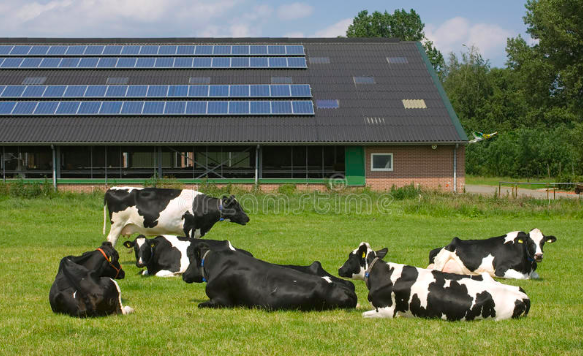
Australian dairy farmers could share energy via a blockchain microgrid

Source: Netherlands Stock Image

Latrobe Valley dairy farmers could be buying and selling locally generated renewable energy using blockchain, with a feasibility study into a ‘virtual microgrid’ being funded by the Australian Renewable Energy Agency (ARENA).

The project will be led by Brooklyn-based energy company LO3 Energy and focuses on the feasibility of creating a ‘virtual microgrid’ across up to 200 dairy farms, over 100 household consumers and around 20 other commercial and industrial customers in the Gippsland region of Victoria. A ‘virtual microgrid’ is a local marketplace of connected energy users who can buy and sell electricity within a localised area.

The virtual microgrid will incorporate solar PV, battery storage, smart appliances and enabling technologies combined with the LO3’s Exergy peer-to-peer energy trading platform which uses blockchain technology to allow participants to securely buy and sell locally produced renewable energy.

Further reading: Latrobe Valley virtual microgrid could allow dairy farmers to trade energy via blockchain. Australian Renewable Energy Agency, April 27, 2018.

Wednesday, 11 April 2018

Royal Australian Navy goes renewable with a microgrid in WA

Installing battery storage at HMAS Stirling (Image: Carnegie)

“When it comes to running the nation’s largest naval base, security and stability are generally pretty important. And not just around electricity supply. That’s why the Department of Defence has decided to plunge headlong into renewable energy, teaming up with ARENA and West Australian company Carnegie on a project to make HMAS Stirling, 61 km south of Perth, the nation’s first military installation with its own energy microgrid.”

It will be “the world’s first renewable energy integrated microgrid that has the option of receiving wave energy [Perth Wave Energy Project] and will produce both power and desalinated water for the base. The Project will involve the construction and integration of 2 MW of photovoltaic solar capacity, a 2MW/0.5MWh battery storage system and a control system and will include augmentation of the grid connection.”

“It highlights the growing interest of military organisations worldwide in investing in renewable energy as a way of increasing energy security and stability.”

Read more:The Navy goes renewable. Australian Renewable Energy Agency (ARENA), July 31, 2017.

Monday, 19 February 2018

Australia's first large-scale solar and battery plant is connected.

Lakeland project, Cooktown, far north Queensland (RenewEconomy)
The first large-scale solar and big battery storage installation in Australia - the Lakeland project near Cooktown in far north Queensland - has been officially connected to the grid. It is at the edge of the very large electricity grid of eastern Australia where electricity supply is not always reliable.

With a smallish population to support, it is a relatively small system of 10.8KW of solar and 1.4MW/5.3MWh of battery storage. Importantly, the system will firm up supply of solar power to the grid and provide ‘islanding’ for the local community whereby homes and businesses can remain connected while there is a fault elsewhere.

This deliberate ‘islanding’ will be a test case where a section of the grid continues to provide power while disconnected from the main grid. A test case that could prove to be important for those areas that are at the extremes of grids or prone to natural disasters such as bushfires, cyclones or floods.

Further reading: Australia’s first large scale solar + storage plant connected to the grid. RenewEconomy, February 19, 2018.